Blog

Learning: The Job of a Lifetime and a Path to Possibility

Paul Graham, co-founder of Y Combinator, states that the most damaging thing we learned in school was learning to get good grades. In his essay, The Lesson to Unlearn, he explains that tests have become something to hack instead of measuring what they’re supposed to, how much we have learned. This encourages students to concern themselves with what could possibly turn up as a test question and trains them into thinking that the way to win is by hacking bad tests.

Consequently, we can start to believe that this is how the world works. We look for tricks on how and what to do instead of taking in new information and simple lessons that are right in front of us. It wasn’t until I attended Lambda School that I understood how entrenched this was in me. This realization prompted me to reflect on my educational experiences as a whole. In doing so, I discovered how conditioned I was to memorize facts for grades, the antidote to active learning.

“The end goal is not to find flaws in the things you’re told, but to find the new ideas that had been concealed by the broken ones.” —Paul Graham

You Don’t Know What You Can’t See

Within the domain of data science, models are used to approximate relationships for prediction and classification. Mental models aren’t drastically different. They are used to help us prepare for a future event by offering different lenses in which to view the world. When applied from different disciplines, mental models enhance the resolution of how the world works.

There are three specific insights I acquired from studying data science that have impacted me in ways that transcend the discipline I discovered them in. They have been useful for helping me undo my conditioning to hack bad tests and led me to expanding my mental toolbox with thinking concepts like mental models. To highlight these insights, I’ve selected a mental model to illustrate each below.

1. Questions are more important than answers.

Asking questions helps us distill problems into their most essential pieces or first principles. First principles as a form of thinking prove to be valuable for problem solving and decision making. Questions enable us to explore depth and dimension, and by using them to deconstruct a problem, we’re able to expose the roots that create a foundation for applying other models.

Mental model: First Principles Thinking

2. “All models are wrong, but some are useful.” — George Box

A model is not reality just like a map is not the territory. For example, let’s say you’re visiting Paris, and you refer to a map to help you navigate around the city. The map you’re holding is representative of Paris at a particular moment in time. Therefore, the map excludes any details of the city as it changes. This idea is essential to keep in mind as we use abstraction and reduction to help guide us through the complexity of our world. Understanding what models and maps tell us allows us to better question and update them as we go.

Mental model: The Map is not the Territory

3. You become what you measure.

Your output is an expression of the thinking and strategy going on behind the scenes. You are falling prey to proxies and predetermined targets if you don’t know what you’re trying to optimize for. What are the metrics that will help you get to where you want to go? It’s easier to illuminate a path to what you want when you know what’s going to help get you there. By asking if what you are doing now is going to get you the results you want in the future, you can weigh the effects of different decisions. Considering “the effects of the effects” is second-order thinking in action.

Mental model: Second-Order Thinking

Each of the ideas above are takeaways that have helped me morph learning into just as much of an artistic and personal endeavor as an intellectual and professional one. As a result, I’ve collided with other cool, useful topics like Personal Knowledge Management, a practice for capturing ideas and insights, and sharing in public, which involves releasing your work for feedback before it’s finished; they are how and why this essay is in front of you now.

Win by Doing Good Work not by Hacking Bad Tests

I thought my success was dependent on how well I was able to hack bad tests until I realized it didn’t have to be. In fact, as the future continues to enable non-routine cognitive and creative work, the reward for being proficient at existing problems over the discovery of new ones is less and less. The ability to look around, see what’s in front of you, and imagine different ways of doing things becomes more valuable than the next tactic or trick. Your relationship with learning is the differentiator.

As my relationship with learning has morphed, so to, has my mindset, worldview, and approach to solving problems. With this, how I think about the world becomes a decision I make every day. By empowering myself to be an active producer of knowledge and ideas, I now know that learning is the job of a lifetime and a path to possibility.
The Life-Changing Magic of Personal Knowledge Management: A Practice for Thriving in the Digital Age

“Personal Knowledge Management (PKM) is the practice of capturing the ideas and insights we encounter in our daily life, whether from personal experience, from books and articles, or from our work, and cultivating them over time to produce more creative, higher quality work.” — Tiago Forte

My official journey into knowledge management began when I came across Tiago Forte on Twitter. The idea of “Building a Second Brain,” a methodology for saving knowledge in an external, centralized place, intrigued me. It wasn’t before long that I became a subscriber of Tiago’s Praxis blog and dove deeper into his work on modern productivity. Each new learning I had was accompanied by increasing excitement, as well as relief, which at the time I didn’t fully understand. However, in thinking about why I had experienced a sensation of comfort, it became clear. The digital world of information abundance has left me as no stranger to disorder, information overload, and simply not knowing what to do with the ideas in my head. At times, it’s felt like a powerless position, and Tiago’s work was the beginning of a solution. Creators like Anne-Laure Le Cunff of Ness Labs and David Perell of Write of Passage have also shared ideas that have contributed to understanding and developing a Personal Knowledge Management system for myself. This has been not only game-changing, but life-changing.

Note: This piece is intended to synthesize fundamental ideas I’ve learned from Anne-Laure, Tiago, and David so far. 

Get Your Mind Right

In an article on her website, Ness Labs, Anne-Laure shares a process she developed called “mindframing.” It has served as an important reference for changing my headspace to create and see things through. I’ve briefly summarized the three main frames of mindframing below. 

Growth Mindset

A growth mindset views talents and abilities as not being fixed. When you believe your abilities can be developed through hard work and dedication, you’re more likely to have a level of patience with the process and persist in times of challenge. More specifically, Anne-Laure emphasizes that a growth mindset is “having the deep belief that growing happens through small, incremental steps, rather than big overnight victories.” 

Metacognition

Do you ever think about thinking? If so, you’re performing metacognition. Anne-Laure describes metacognition as “your knowledge of what you do and don’t know, as well as all the strategies you use for learning and problem solving.” For example, implementing a productivity strategy that supports your ability to write more consistently is metacognition in action. The more aware you are of how you understand, retain, and reuse information, the more feedback you have for iteration.

Self-authorship

Self-authorship is grounded in personal authority. It’s accepting that although you can’t control external realities, you can control the way in which you react to them. There are three specific ways we can develop more self-authorship: 1) question our values and beliefs, 2) hang out with diverse people, and 3) take responsibility. 

“You can have the best tools and strategies, but if you don’t have the right mind frame, things are not going to work.”  — Anne-Laure Le Cunff

Developing Your Personal Knowledge Management System

Personal Knowledge Management depends on an active relationship with information consumption. We can facilitate this with our mindset and an “information diet.” When hearing the word diet, you may hesitate and think of deprivation, however don’t be wary. An information diet often leads to higher quality information, which like any more nutritious food source, contains a higher concentration of value for sustenance. Active information consumption not only consists of being more thoughtful about the information you intake, but also relies on a creative process to build knowledge. The combination of these two things leads to a transformation. David Perell says, “It’s a fundamental transformation of going from a pure passive consumer of the world to an active producer in it.”

A Producer’s Workflow

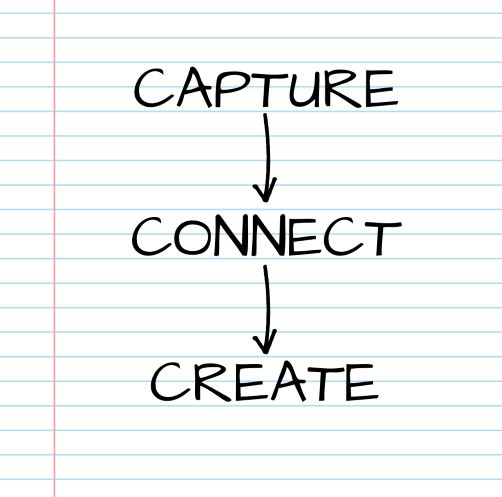
Tiago sequences “Building a Second Brain” into three fundamental steps, capture, connect, and create. These steps provide a high level overview of what a producer’s workflow entails.

Capture

What information is worth saving?

We are consuming raw information all the time. From books to articles to podcasts to Twitter feeds, information has a way of coming at you in all directions. But how do you determine what information is worth saving or not? Intuition, curiosity, and usefulness drive most of my information decision making. I’ve chosen to filter information this way to help keep it personal and relevant.

When it comes to consuming the information I save, I picked up an important productivity trick from Tiago. The trick: Save the information you come across for future consideration. I’ve been down plenty of information rabbit holes, which usually lead to time consuming, distracting detours. Have I experienced unique, creative inspiration from following a spark in the moment? Yes, and there are times I embrace that spontaneity, however more often than not, it’s proven to be unproductive. By saving information for a later time, you can be that much more intentional when you go back to review it. 

How do you store notes?

The P.A.R.A. (Projects, Areas, Resources, Archives) method developed by Tiago can be used as the heart of your PKM system. It’s centered on organizing notes based on projects you’re actively working on. Why organize notes this way? Tiago says, “This ensures that you are consuming information with a purpose — to advance your projects and goals — and only at a time and place where you’ll be able to put it to use.” If you’re interested in learning more about P.A.R.A., Tiago explains it in more detail here

Capturing information is the most tool heavy part of Personal Knowledge Management, and I suggest experimenting through trial and error. It’s also helpful to read about and watch how other people use note-taking tools like Evernote, Notion, Obsidian, and Roam Research. This will help you find the tools that support the most optimal, integrated system for you. The key is that you structure and systematize your note-taking in a way that creates flexibility, clarity, and less resistance. In the words of James Clear, “Systems are best for making progress.”

Connect

You now have information to take notes on, but how do you take those notes and get them into a state where they’re ready to be applied?

Tiago developed a technique he calls progressive summarization that’s designed to make notes more discoverable and presented in a way where context isn’t lost. The truth is that summarizing is hard, and that’s largely because we don’t often know what a note is going to be used for. You’re summarizing in the present for the future. Fortunately, a technique like progressive summarization is performed in layers, which leaves an obvious trail of your intellectual exploration.

“The challenge is knowing which knowledge is worth acquiring, and then building a system to forward bits of it through time, to the future situation or problem or challenge where it is most applicable, and most needed.”  — Tiago Forte

Note: Looking to dive deeper into note-taking? I suggest reading Sonke Ahren’s book, How to Take Smart Notes, which explores the note-taking method of Zettelkasten.

Create 

John Mayer in a clinic at Berklee College of Music told students, “Your hardest job is to convert information into your inspiration.” By unloading your thoughts and ideas into an organized space, you’re freeing your biological brain to imagine and create, all while making it easier to synthesize information. The ability to combine ideas in interesting and inspiring ways is a core goal of Personal Knowledge Management.

Sharing in Public

Sharing in public involves documenting and releasing your work for feedback before it’s finished. When discussing the benefits, Anne-Laure says, “Done properly and in a way that fits within your workflow, it will dramatically increase your productivity and creativity.” By sharing in public, you can begin to make connections between your own ideas and other people’s ideas. It’s like giving your ideas oxygen, and the chance to expand. The world is a network of ideas. Your ideas are the most powerful when they are out in it.

“The Internet rewards people who learn in public.” — David Perell